
10.31.2025
ROADRUNNER IN SPRING

CRAFT NOTE
. . . in case you find this sort of thing helpful, or simply interesting.
I’m two weeks into a four-week generative workshop (“The Poetic Laboratory: Science & Lyric Imagination”) offered online by Denver’s Lighthouse Writers Workshop and led by Radha Marcum.1 In preparation for this week’s meeting, we were invited to use scientific terminology in a poem of eight to twelve lines mentioning a natural phenomenon we’d encountered.
I didn’t have to look beyond my garden wall. The rest was drawn from my memory of Sir David Attenborough’s The Life of Birds, specifically episode 7, “Finding Partners.”
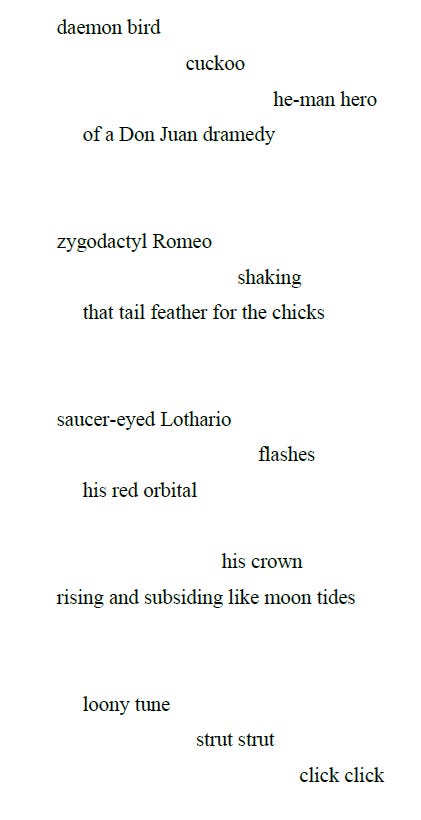
The resulting poem appears to have fifteen lines—three more than the specified maximum. But to my mind, the poem consists of four couplets, with lines alternating between nine and seven syllables:
daemon bird cuckoo he-man hero
of a Don Juan dramedy

zygodactyl Romeo shaking
that tail feather for the chicks

saucer-eyed Lothario flashes
his red orbital his crown

rising and subsiding like moon tides
loony toon strut strut click click
What explains the apparent discrepancy?
To begin with, I found myself wanting to write in fragments rather than full sentences—flashes of imagery and pure observation interspersed with associated perceptions. That choice immediately allowed me to lowercase everything, since nothing had to start with a capital letter (or end with a period, for that matter). And do we really need to run around plastering our uppercase onto natural phenomena that are out there just minding their own business?
With capital letters and end punctuation gone, it made sense to lose the commas, too. Doesn’t an all-lowercase poem with commas look like a man wearing spats with a Speedo? I could have substituted white space for the omitted commas, a frequent practice in poems like this one. Instead, I used line breaks (and in one case a stanza break, between “his red orbital” and “his crown”) along with five spaces before the continuation of each broken line.
Meanwhile, I placed the first line of each couplet flush with the page’s left margin and used a five-space indent before each couplet’s second line.2
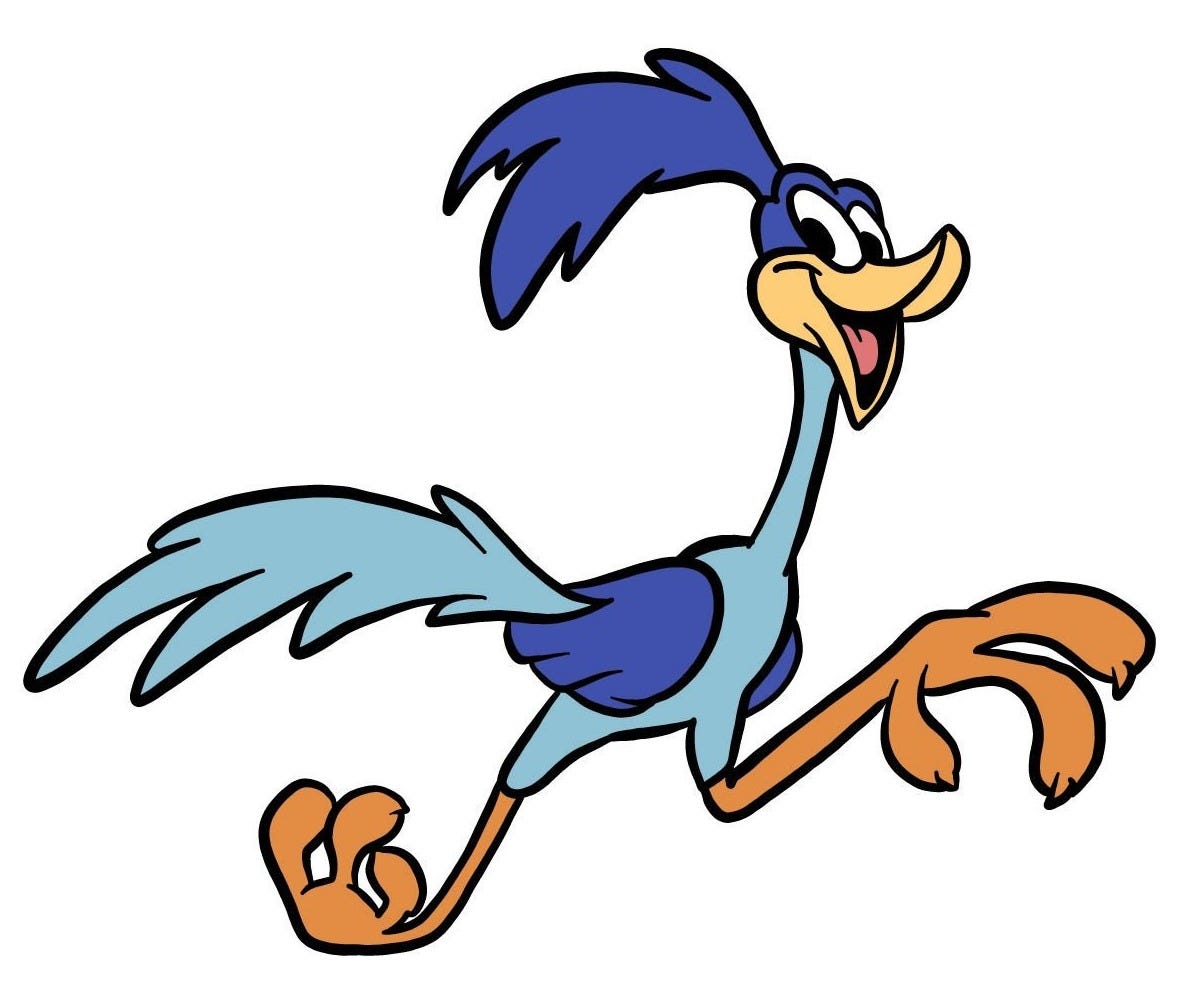
But the Greater Roadrunner—largest member of the Cuculidae (cuckoo) family, such a comical bird! I’ve seen roadrunners commit first-degree murder in my own yard, and still I’ve forgiven them. It seems I can’t stop writing about them. I adore them.
The last generative workshop I took from Radha, also through Lighthouse, was “Breaking Form,” where we were encouraged to find our way into or out of received forms in new ways. Not sure I managed that, but I did write a third of what became Mortal Sugar: Poems in the Key of Lotería (Monday Editions, 2025). There are 12 signed and numbered copies left of Mortal Sugar’s first, limited edition (100 copies, in three printings). The second (open) edition is here.
The objective of steps 2 and 3 was to create a cantilever pattern mimicking the roadrunner’s characteristic zigzag gait. What do you think?
"Doesn’t an all-lowercase poem with commas look like a man wearing spats with a Speedo?"
😂💛!!!
"a man wearing spats with a Speedo"
Spit laughing here, knowing that I don't use commas. Except when I do.